
Bridge Constructor Portal: Build Bridges Using Portal Logic
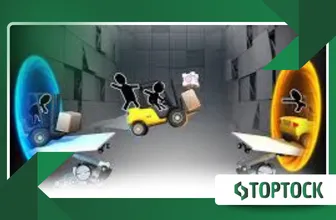
The architectural chaos of Bridge Constructor Portal represents a rare moment where a licensed spin-off actually outshines its predecessors by embracing pure, unadulterated spatial frustration.
Anúncios
Summary
- Engineering meets Aperture Science’s cynical testing.
- Physics of momentum and portal placement.
- Hardware performance benchmarks for 2026.
- Strategic structural integrity for convoy survival.
- The psychological weight of GLaDOS’s commentary.
What Defines the Aperture Approach to Engineering?
Blending two distinct genres is a delicate act, yet Bridge Constructor Portal pulls it off by forcing players to unlearn everything they know about static weight distribution.
Most construction simulators treat a bridge as a destination; here, the bridge is often just a high-speed launchpad designed to hurl a forklift into a neon-blue void.
You aren’t just an architect; you are a participant in a series of lethal experiments where traditional steel beams frequently fail to account for the “flinging” mechanics of interdimensional travel.
Ellen McLain’s return as GLaDOS provides more than just nostalgia. Her voice adds a layer of existential pressure, reminding you that while the bridge might stay up, your career—and your life—at Aperture Laboratories is perpetually on the line.
Anúncios
The game thrives in this tension. It asks you to respect the cold reality of gravity while simultaneously exploiting a physics engine that allows a van to teleport across a room at terminal velocity.
Why Is Momentum More Important Than Stability?
Solving these chambers requires a shift in perspective: stability is often a secondary concern compared to the conservation of mass and speed. In Bridge Constructor Portal, a bridge that doesn’t “bend” is a bridge that snaps under the violent entry of a vehicle exiting a portal.
Standard triangles provide the foundation, but the real genius lies in predicting how a vehicle’s arc will change once it hits the orange threshold. It is a strange, rhythmic dance of structural reinforcement and trajectory mapping.
Gravity isn’t a constant force here; it’s a tool. By dropping a vehicle from a significant height into a portal, you generate the kinetic energy needed to clear massive gaps that no amount of steel cabling could ever span.
++ Kami 2: Fold Paper Puzzles to Fill Every Screen Beautifully
This is where the game gets under your skin—you’ll find yourself staring at a screen for twenty minutes, adjusting a single strut by a fraction of a degree just to ensure a smooth landing.
How Do Gels and Turrets Complicate Your Blueprints?
The introduction of Propulsion and Repulsion Gels turns a simple bridge-building exercise into a chaotic management of friction and bounce.
Splashing orange gel across a runway changes your structural requirements instantly, as the increased speed places exponential stress on your joints.
Lasers and turrets add a layer of environmental hostility. You aren’t just building for gravity; you’re building for survival, often using weighted companion cubes to shield your convoys from being vaporized mid-air.
There is a specific kind of “Aperture Logic” required to navigate these hazards. Sometimes, the solution isn’t a better bridge, but a more creative way to redirect a laser into a thermal discouragement socket.
For those interested in the deep lore and mechanical origins of these testing elements, the official Portal 2 website remains a vital archive of Aperture’s questionable scientific history.
Which Platforms Still Deliver Peak Performance?
Even in 2026, the game’s stylized aesthetic remains crisp, running flawlessly on everything from integrated mobile chipsets to dedicated gaming rigs. It’s a testament to optimized design over brute-force graphics.
Read more: Brain It On!: Physics-based Puzzles That Require Creative Solutions
PC and Steam Deck remains the definitive way to play, primarily because the precision of a mouse or high-quality trackpad makes the minute adjustments of cable tension far less tedious during the later, more sadistic levels.
| Feature | Minimum Specification | Recommended (2026) |
| OS | Windows 10 / macOS 11 | Windows 11 / Latest macOS |
| Processor | 2.0 GHz Dual Core | 3.5 GHz Quad Core |
| Memory | 4 GB RAM | 8 GB RAM |
| Graphics | Integrated Graphics | Dedicated GPU (RTX 20-series+) |
| Storage | 200 MB Space | 500 MB (Cloud Saves) |
When Should You Pivot Between Struts and Cables? Bridge Constructor Portal
One of the most common pitfalls is over-relying on rigid steel struts when the solution clearly calls for the flexibility of suspension cables. Steel is excellent for taking the brunt of a direct landing, but it’s brittle under the swaying resonance of a full convoy.
Cables allow for “floating” designs, where you can anchor your roadway to distant walls or ceilings, bypassing the need for expensive, ground-up scaffolding that often gets in the way of portal paths.
The most elegant solutions usually look like a mess—a hybrid of rigid triangles at the impact points and a spiderweb of cables to catch the vibration of the following vehicles.
++ Archery Master 3D: Aim True and Compete in International Tournaments
Efficiency is measured by your budget, and while GLaDOS might not care about the cost, your engineering pride should. Minimalist designs aren’t just cheaper; they are often more resilient to the game’s unpredictable physics.
What Are the Realities of Convoy Testing?
The true test of any bridge isn’t the first van; it’s the fifth. Convoy mode introduces a rhythmic stress that can turn a perfectly stable structure into a pile of scrap metal in seconds.
As multiple vehicles move across your bridge, they create waves of tension. If your joints are too stiff, the bridge will shake itself apart. You have to design with “give” in mind, allowing the structure to breathe as the weight moves across it.
The thermal heat map is your best friend during these failures. It highlights the exact moment a beam turns from a healthy green to a stressed red, giving you a visual cue of where the structural “exhaustion” is happening.
If you find a bridge failing halfway through a convoy, don’t just add more material. Try changing the entry angle of the vehicles. Often, a smoother transition is worth more than a thousand extra steel beams.
Final Thoughts
The brilliance of Bridge Constructor Portal isn’t found in the moments where everything goes right, but in the spectacular, slow-motion collapses that happen when you forget a single cable.
It’s a game that rewards curiosity and punishes hubris, all while maintaining a pitch-black sense of humor. In the landscape of modern logic puzzles, it remains a rare example of a crossover that feels intellectually honest to both of its source materials.
If you’re looking to dive deeper into the corporate culture that birthed these “tests,” visit the Valve Corporation site for a broader look at their design philosophy.
FAQ (Frequently Asked Questions)
Why does my bridge collapse only during the convoy phase?
This is usually due to harmonic resonance. The weight of multiple vehicles creates a rhythmic vibration that exploits weak points that a single vehicle wouldn’t trigger. Reinforce the center of your spans.
Can I skip the dialogue and just build?
Technically yes, but you’d be missing out on the narrative soul of the game. GLaDOS’s observations are often designed to distract you, which is part of the intended psychological challenge of the test.
Is there a “correct” way to solve a level?
Absolutely not. The game tracks your budget and material usage, but as long as the convoy reaches the exit, the solution is valid. Some of the best solutions are the most structurally questionable.
Does the game support community-made levels?
On PC, the Steam Workshop is active with hundreds of community chambers that range from instructional tutorials to puzzles that make the base game look like child’s play.
++ Bridge Constructor Portal Review
Popular Now