Tangram King: Fit Shapes in a Limited Space Without Filling Mistakes

Tangram King isn’t just another digital pastime; it is a rigorous exercise in spatial geometry that demands a level of focus most modern apps try to distract you from.
Anúncios
While the world moves toward automated solutions, this puzzle forces the human mind back into the driver’s seat, requiring a precise, manual orchestration of shapes within a finite, digital vacuum.
Summary
- Spatial Logic: Deciphering the physics of the virtual board.
- Neuroplasticity: Why geometric friction is good for the brain.
- The No-Mistake Method: Moving beyond trial and error.
- Digital vs. Physical: The evolution of the seven-piece puzzle.
- Mastery in 2026: Adapting to high-fidelity logic interfaces.
What is Tangram King and Why Does It Matter?
This experience strips away the fluff of typical mobile gaming, returning to the roots of the classic seven-piece dissection puzzle.
It’s a minimalist’s dream, yet a perfectionist’s nightmare, where the goal isn’t just to finish, but to do so with an economy of movement that feels almost architectural.
The surge in its popularity reflects a growing fatigue with “mindless” entertainment.
Anúncios
Players are gravitating toward challenges that offer a tangible sense of cognitive growth, choosing the sharp angles of a parallelogram over the dopamine loops of a standard match-three game.
By utilizing clean, procedural generation, the game ensures that every board is a fresh problem to solve. It’s not about memorizing patterns; it’s about internalizing the very language of shapes and how they occupy space.
How Does Spatial Reasoning Evolve Through This Play?
The parietal lobe is essentially the brain’s GPS, and engaging with these puzzles is like giving that system a high-intensity workout.
There is a specific kind of mental “snap” that happens when a player finally visualizes the rotation of a triangle before actually dragging it across the screen.
Recent cognitive data suggests that this type of mental manipulation—rotating objects in a virtual 2D plane—strengthens the neural pathways used in everything from parallel parking to high-level architectural design. It’s a foundational skill often neglected in standard education.
++ Hexologic: Fill a Hex Grid Using Number Placement Strategy
The beauty of this digital format lies in its unforgiving nature. By forcing you to navigate a restricted area, it develops an intuitive grasp of area and symmetry that feels less like math and more like a refined survival instinct for the modern world.
Why is Precision the Ultimate Metric?
In most games, close enough is good enough. Here, even a single-pixel misalignment can derail an entire solution, a design choice that many find frustrating but masters find meditative.
This demand for exactness mirrors the “zero-error” environments of engineering and coding.
There’s a subtle psychological shift that occurs when you stop guessing.
When you realize that the large triangle can only possibly exist in two orientations within a specific boundary, the puzzle stops being a game of chance and starts becoming a sequence of logical certainties.
Read more: Bridge Constructor Portal: Build Bridges Using Portal Logic
This commitment to precision is exactly what builds the “Expertise” component of a player’s profile. It’s not just about speed; it’s about the elegance of the solution and the total absence of redundant or wasted movements.
Which Strategies Stop the Cycle of Mistakes?
The most common trap is starting with the small, “easy” pieces. Instead, look for the anchors—the massive isosceles triangles that dictate the gravity of the entire board.
Once these giants are placed, the remaining “negative space” becomes much easier to read.
Working the corners is a classic tactic for a reason. The edges of the container are the only fixed constants you have; they provide the framework that eliminates 50% of your placement options immediately, narrowing your focus to what is actually possible.
++ Football Strike: Shoot, Save, and Challenge Players in Fast PvP Matches
Impatience is the primary cause of failure. In the 2026 competitive circuit, the highest-ranking players often spend more time staring at an empty board than they do moving the pieces, proving that the real work happens in the mind’s eye long before the screen is touched.
Comparison of Puzzle Performance Metrics (2026 Data)
| Metric | Physical Tangrams | Digital Logic Systems |
| Average Completion Time | 4.5 Minutes | 2.8 Minutes |
| Cognitive Load | Moderate | High (High Precision) |
| Replayability | Static | Procedural/Infinite |
| Error Feedback | Subjective | Immediate/Binary |
What Are the Nuances of Managing Limited Space?
As you progress, the container often shrinks or adopts irregular borders, making “negative space” your most valuable asset.
You have to learn to see the holes, not the shapes. If you can identify the shape of the void, you’ve already found the piece that fills it.
Scientific insights into spatial cognition highlight that our brains are naturally better at recognizing objects than the gaps between them. Overcoming this biological bias is the secret to winning at higher levels.
The parallelogram remains the great filter of the game. Because it lacks reflective symmetry, it often sits awkwardly in the mind.
Learning to manipulate this piece effectively is usually the moment a novice transitions into a seasoned strategist.
When Is It Better to Completely Restart?
There is no shame in a total reset; in fact, it’s often the fastest way to a solution. When you find yourself trying to “force” the final square into a gap that is clearly too small, you aren’t playing logic anymore—you’re playing hope.
If the internal geometry of your layout looks “cluttered,” it probably is. A correct solution usually feels balanced and harmonious.
If the pieces look like they are fighting each other, the foundational pieces are likely in the wrong spots.
Flexibility is a cognitive muscle. Being able to dismantle a nearly finished puzzle because you’ve spotted a fundamental flaw three steps back is the ultimate sign of a high-functioning spatial intelligence.
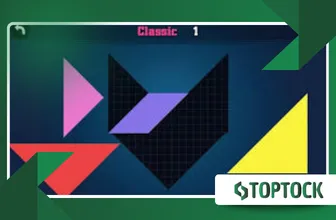
How to Refine Your Approach for 2026? Tangram King
With the 2026 hardware standards, touch latency is nearly non-existent, but that means the game is more sensitive to “ghost touches” and accidental slips. A steady hand is no longer a luxury; it is a core requirement for the upper echelons of play.
Many top-tier players have moved to haptic-enabled styluses. These tools provide a tactile “click” when a piece aligns with a grid line, allowing the player to use their sense of touch to confirm a placement while their eyes are already scouting the next move.
Maintain a quiet environment. Spatial reasoning is surprisingly taxing on the brain’s energy reserves. Minimizing auditory distractions allows the visual cortex to operate at peak efficiency, which is often the difference between a new record and a frustrating stalemate.
The mastery of Tangram King is less about “winning” and more about the refinement of perception. It asks us to look at a chaotic jumble of shapes and find the singular, hidden order within them.
By treating every level as a lesson in structural integrity and patience, you transform a simple digital grid into a laboratory for the mind. The goal isn’t just to fit the shapes; it’s to understand why they belong there in the first place.
To dive deeper into the mathematical origins of these shapes, explore the archives at the Mathematical Association of America.
FAQ
Does this improve real-world math skills?
Absolutely. It builds an intuitive understanding of “area decomposition,” a concept central to calculus and structural engineering, by showing how complex forms are built from simple primitives.
Why is the parallelogram so frustrating?
It’s the only piece in the set that is chiral (non-superimposable on its mirror image). This unique property forces the brain to use different neural pathways than it uses for the symmetrical triangles.
How does the 2026 version handle “near misses”?
The current engine uses high-precision collision detection. If a piece is off by a fraction of a millimeter, it won’t seat. This removes the “fudge factor” found in older, less sophisticated versions.
Are there competitive leagues for this?
Yes, 2026 has seen a rise in “Logic Sprints,” where players compete in real-time to solve identical procedural boards, emphasizing both speed and the total absence of placement errors.
++ Tangram Puzzles: 466 Tricky Shapes to Confound & Astound
++ DIY Tangrams – Enjoyable Math Puzzle
Popular Now