Merge Gardens Efficient Resource Management for Beginners
Running out of open tiles while coins, wood, eggs, and reward bubbles pile up is the fastest way to stall progress in Merge Gardens.
Anúncios
Developed by Futureplay and published by Plarium, the game blends match-3 puzzles with garden restoration at Myrtlegrove Estate, where space is your scarcest resource.
Learning how to merge in fives, organize zones, store bubbles, and spend gems selectively turns an overcrowded map into a steady production engine.
Key Takeaways
- Merge five items instead of three: Merging five identical items yields two higher-tier items instead of one, increasing your resource output by 20% over time.
- Treat bubbles as free off-board storage: Keep reward bubbles unopened and stacked by category until you need the items for a quest or have enough copies for a five-merge.
- Focus on two or three merge chains at once: Spreading your tiles across a dozen item lines clogs the board; sell easily replaceable stage-one clutter when you are not actively building that chain.
- Protect your gems and coins for high-value milestones: Never spend gems on extra puzzle moves; save them for creature nests or event bonuses, and merge coins up to top tiers before collecting.
Why Board Space Is Your Most Valuable Resource in Merge Gardens
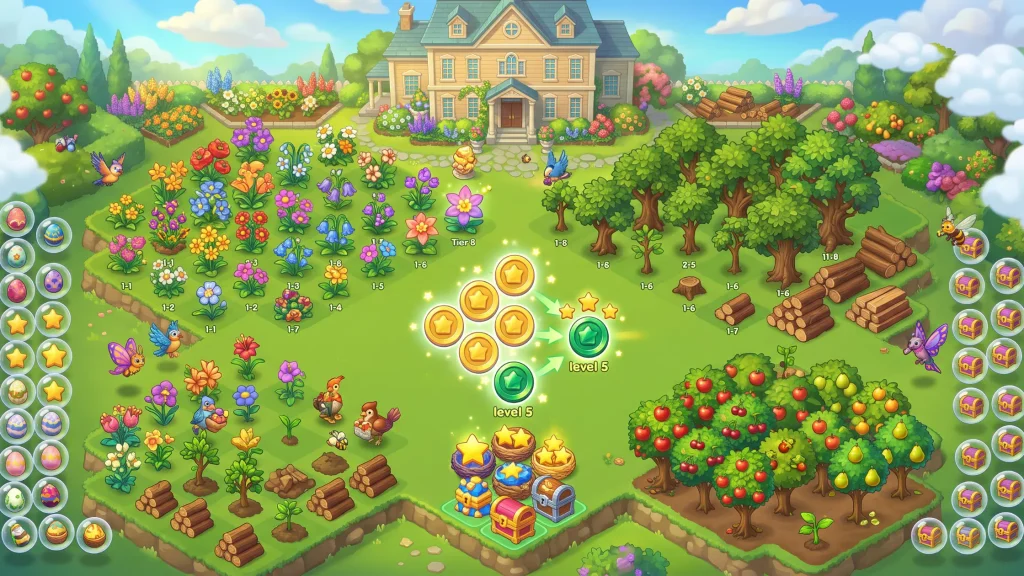
Every merge chain in Merge Gardens—from Wildflowers and Oak Trees to Coins, Wood, and Wildlife—requires open tiles to spawn, sort, and combine items.
When your board fills up, wildlife cannot harvest materials, floating seeds have nowhere to land, and simple merges turn into tedious tile-shuffling.
Anúncios
Good resource management is less about hoarding every item you find and more about controlling what occupies your tiles.
When you manage space deliberately, you unlock Evergrowth fog faster, finish Daisy’s Quests with fewer bottlenecks, and build high-tier producers that generate passive rewards.
How to Use the Five-Merge Rule Without Getting Stuck
Why Merging in Fives Matters
The default tutorial teaches players to merge three identical items, which produces one item of the next tier. Merging five identical items produces two items of the next tier.
Over a 10-stage merge chain, relying on three-merges costs drastically more raw materials and wildlife stamina than waiting for five-merges.
Apply the five-merge rule strictly to high-value chains:
- Wildlife eggs and nests
- Coins and wood piles
- Gems and gem mines
- Stars and treasure chests
- Mid-to-high-tier flowers and trees
When a Three-Merge Makes Sense
Strict five-merging has two practical exceptions for beginners. First, when you reach the final Masterpiece stage of a chain, a three-merge is fine if you only want one copy of that wonder on your board.
++ Sunny House Puzzle Challenges Hidden Behind Garden Quests
Second, if your board is completely locked with zero free tiles and nothing left to sell, executing a single three-merge to open breathing room beats halting all progress.
Core Resources and How to Manage Each One
Different resources in Merge Gardens serve distinct roles in estate progression. Grouping items into dedicated corners of your garden keeps harvest drops organized and makes five-merges easy to spot at a glance.
| Resource Type | Primary Role | Best Beginner Strategy | Common Mistake to Avoid |
| Coins | Buying eggs, trunks, and shop items | Merge in fives up to the highest tier before collecting into your bank | Tapping low-level bronze coins early, which wastes most of their total value |
| Wood | Purchasing supply trunks in the shop | Maintain one or two mid-level Oak Trees and merge wood piles in fives | Collecting small logs before merging them into full timber stacks |
| Gems | Unlocking rare nests, task skips, and bonuses | Merge free gems in fives and save them for high-impact upgrades | Spending gems on extra moves in match-3 puzzles |
| Stars | Releasing eggs, nests, and high-tier rewards | Save and merge stars in fives until reaching stage six | Tapping stage-one or stage-two stars immediately after winning a level |
| Wildlife | Harvesting trees, flowers, and honeycombs | Merge eggs in fives and target high-yield producers like Honey Trees | Letting wildlife auto-harvest random low-tier clutter |
Coins and Wood Storage
Before collecting large coin piles or timber stacks, check your storage capacity. If your Coin Storage or Wood Storage is full, excess value is wasted or left behind.
Read more: Match Factory Smart Sorting Techniques That Improve Scores
Keep your storage buildings upgraded alongside your main chains, and always merge coins and wood to their peak tiers before tapping them into your reserves.
Gems and Match-3 Puzzle Lives
Match-3 puzzles are how you earn stars, reward supplies, and quest progress, and you can learn more about the game’s core puzzle loop on the official Merge Gardens website.
Because puzzle lives replenish automatically over time, spending gems for five extra moves is rarely worth the cost. Save your gems for 20-gem egg nests, strategic quest skips, or bonus event prize tracks that accelerate wildlife score.
Smart Habits That Prevent Clutter and Save Time
1. Keep Reward Bubbles Unopened Until Needed
Whenever you win a match-3 puzzle, complete a trade, or earn a daily delivery, rewards arrive floating in bubbles. Bubbles do not take up garden tiles.
Drag unopened bubbles to the edges of your map and sort them into separate stacks—one stack for eggs, one for stars, and one for garden supplies.
++ Count Masters Battle Event Introduces New Team Mechanics
Pop them only when you have open workspace or when an active quest asks you to open supplies.
2. Turn Off Auto-Harvest and Enable Merge Previews
In the game settings, turn off auto-harvesting so your creatures stop filling empty spaces with random leaves, acorns, and low-tier sprouts while you organize.
Enable the merge counter and hover preview options as well; seeing whether a group has three, four, or five items prevents accidental three-merges during fast play.
3. Build Sustainable Production Chains Early
Rather than working on every discovery chain at once, pick two or three complementary chains:
Fruit Trees and Wildflowers: Fruit trees regularly spawn flower sprouts around their base, letting you advance both chains simultaneously without spending extra wildlife stamina.
Honey Trees: Harvesting high-level Honey Trees yields honeycombs that merge into coins, baskets, and free bee eggs, making them one of the strongest early coin and wildlife engines.
Oak Trees: Oak Trees provide reliable wood harvests, which you can spend in the shop on trunks that speed up other chains.
If stray stage-one items like pebbles, poplar leaves, or bark scraps appear from chains you are not currently building, sell them for coins rather than letting them sit idle.
You can review full chain trees and upcoming level requirements on the community-maintained Merge Gardens Wiki before deciding which items to keep.
Conclusion
Efficient resource management in Merge Gardens comes down to discipline with space, patience with five-merges, and focus on a few high-value chains at a time.
When you stop treating every tile as permanent storage and start using bubbles, zone sorting, and targeted harvesting, leveling up becomes smoother and far less repetitive.
For your next session, clear the center of your garden, sort your existing items into dedicated corners, and commit to merging exclusively in fives until your next level-up.
Frequently Asked Questions
Should I always merge five items in Merge Gardens?
Yes, five-merging should be your default habit for eggs, coins, wood, gems, stars, and mid-to-high-tier plants because it gives two upgraded items instead of one.
The only common exceptions are creating a single Masterpiece at the end of a chain or clearing a completely full board when no items can be sold.
How do I get more space in my garden quickly?
First, stop popping reward bubbles until you need the items inside, and stack existing bubbles neatly along the borders of your map.
Second, merge all scattered groups of five, collect max-tier coins and wood, and sell low-level stage-one items from chains you are not actively working on.
What is the best way to spend gems as a beginner?
Avoid spending gems on extra moves when you fail a match-3 puzzle, since lives regenerate on their own.
Instead, save merged stage-three gems for 20-gem egg nests in the shop, occasional skips for overly slow quests, or high-value event reward tracks.
Which merge chains should beginners prioritize first?
Start with Wildflowers, Fruit Trees, Oak Trees, and Honey Trees.
Wildflowers are required throughout Daisy’s Quests, Fruit Trees passively spawn flower sprouts, Oak Trees supply wood for shop trunks, and Honey Trees generate steady coins and bee eggs.
++ Merge Gardens: Best Merge Combinations to Maximize Your Garden Growth
++ Merge Gardens Gameplay: Unlocking New Merges
Popular Now