
Happy Glass Puzzle Update Brings Creative New Mechanics
Mobile puzzle games thrive on clear physics and satisfying solutions, but maintaining player engagement requires continuous innovation.
Anúncios
The latest Happy Glass Puzzle Update introduces fresh interactive elements, transforming simple liquid-routing levels into intricate spatial challenges.
These new physics mechanics test dynamic timing, spatial awareness, and resource efficiency.
Key Takeaways
- Interactive environmental portals alter fluid momentum and destination points.
- Temperature zones dynamically change water state into ice or steam mid-flight.
- Gravity-reversal pads allow for non-linear puzzle architectures.
- Advanced scoring metrics reward minimalist drawing techniques and minimal water waste.
- Refined engine performance delivers smoother frame rates during complex fluid simulations.
What Are the New Mechanics in the Happy Glass Puzzle Update?
The core gameplay loop of Happy Glass has always relied on drawing precise lines to guide water into a smiling glass container.
Anúncios
This newest release expands that formula by introducing dynamic line modifiers and reactive environmental obstacles.
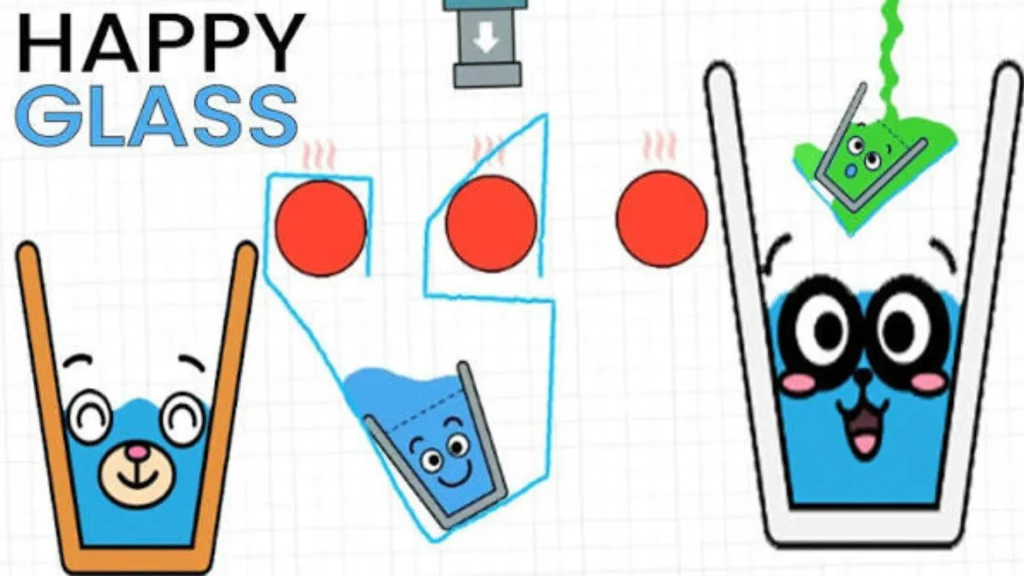
Instead of static barriers, players now interact with dynamic portals, thermal chambers, and localized gravity fields.
Portals serve as dynamic spatial links across the playfield. Passing water streams through an orange portal immediately redirects the liquid out of a paired blue portal, retaining velocity and stream thickness.
This mechanic forces players to calculate exit trajectories rather than relying on standard downward gravity slopes.
Thermal chambers introduce state-of-change physics directly to the water stream.
Hot zones vaporize water into rising steam, requiring inverted cup placement or overhead catch barriers.
Cold zones instantly freeze flowing water into solid ice blocks, converting fluid dynamics problems into structural weight and balance challenges.
Absorptive sponge platforms introduce an active time constraint to level solutions.
Liquid contacting these porous blocks reduces total fluid volume rapidly. Players must engineer line paths that completely bypass these surfaces or direct streams at high velocity to minimize contact time.
| Mechanic Type | Environmental Effect | Player Strategy Shift | Primary Hazard Level |
| Spatial Portals | Instantaneous relocation of fluid vectors | Trajectory projection & momentum control | Moderate |
| Thermal Zones | Phase change (Liquid to Steam or Ice) | Structural building & inverted collection | High |
| Gravity Pads | Vector reversal in localized zones | Upward line routing & counter-weight balance | High |
| Absorptive Surfaces | Fluid volume reduction upon contact | Zero-touch line placement & speed routing | Extreme |
How Do Gravity Pads Change Level Design?
Gravity-reversal pads alter fundamental fluid behavior within localized bounding boxes.
Standard water streams move toward the bottom of the screen due to simulated downward acceleration.
Entering a gravity pad causes water to flow upward toward inverted glasses positioned at the top of the grid.
++ Stack Jump Record Attempts Continue Trending Among Fans
These pads require multi-tier line setups. Players must construct initial guide lines to direct water into the gravity field, followed by secondary inverted funnels to catch upward-flowing liquid.
This dual-phase approach adds depth to late-game puzzles, eliminating single-line trivial solutions.
Spatial planning becomes significantly more complex when gravity pads overlap with portals.
A stream entering an upward gravity pad can be funneled directly into a ceiling portal, exiting out of a side portal with horizontal momentum.
Managing these multi-directional fluid vectors demands careful analysis before drawing the first stroke.
Designing around variable gravity fields requires an understanding of fluid dynamics simulations.
Developers frequently utilize frameworks detailed in ACM SIGGRAPH Research Papers, to simulate real-time surface tension and boundary conditions in mobile physics engines.
Applying these principles ensures that fluid streams remain predictable even when directional forces shift instantaneously.
Why Is Line Efficiency Crucial for Three-Star Ratings?
Achieving a three-star rating now depends on ink conservation and fluid preservation. Historical levels evaluated performance primarily based on ink meter consumption.
The updated scoring engine measures both remaining ink reserves and the exact volume of water safely delivered to the glass.
Read more: Johnny Trigger Missions Deliver Faster Action Sequences
Spilling liquid reduces the final score multiplier instantly. Drawing longer, heavier barriers consumes the ink bar rapidly, making single-stroke minimalist solutions mandatory for top leaderboard placement.
- Minimize surface contact between drawn lines and water streams to reduce friction loss.
- Utilize natural level geometry rather than building complete ink structures.
- Direct water into high-velocity narrow streams to avoid splash dispersion.
- Trigger mechanics using short momentum-redirection pegs instead of full walls.
- Anchor floating structures against existing fixed level pegs to save ink volume.
Understanding the weight distribution of drawn lines is equally vital. The physics engine treats thick drawn shapes as solid rigid bodies with actual mass.
++ Frostpunk Beyond the Ice Survival Mechanics Explained
Creating an overly top-heavy funnel can cause the structure to tip over and block the liquid stream entirely, ruining an otherwise valid path design.
How Does the Update Improve Physics Performance?
Mobile hardware demands efficient computing algorithms to handle real-time fluid particle interactions without dropping frame rates.
Optimization passes in this patch reduce particle overlap calculations, allowing smoother renders on mid-range smartphones.
Advanced particle grouping algorithms group contiguous fluid droplets into cohesive stream clusters.
This reduces the total number of collision checks required every frame while preserving realistic fluid motion and realistic splashing behaviors upon impacting surfaces.
Independent benchmarking and mobile software analyses published via IEEE Xplore Digital Library, highlight how modern mobile graphics pipelines process hardware-accelerated 2D physics engine updates efficiently.
These technical refinements ensure consistent frame pacing when hundreds of individual water droplets interact with custom player geometry simultaneously.
Reduced processing overhead prevents input lag during critical line-drawing moments. Smooth line rendering enables exact angles, preventing unexpected water leakage through small line gaps.
What Are the Best Strategies to Master New Levels?
Succeeding in the upgraded stage packs demands systematic problem-solving over guess-and-check drawing. Analyzing level layouts prior to drawing the initial stroke saves ink and prevents instant resets.
First, identify the primary environmental hazards between the source pipe and the glass target. Note thermal zones and gravity boundaries to map out necessary stream pathing.
Second, test small redirection pegs rather than full enclosure ramps.
A single small dot or minor angled line often redirects fluid momentum enough to clear large gaps without consuming significant ink.
Third, analyze the structural stability of your intended design. Gravity-reversal fields exert upward force on drawn objects, meaning unanchored lines inside these zones will float away unless wedged against solid terrain pegs.
Finally, account for fluid inertia when designing ramps into portals.
Water entering a portal at high velocity exits with equal force, requiring wider collection funnels at the output end to prevent spillage.
FAQ
How do I unlock the new mechanic stages in Happy Glass?
Complete all core stage packs through Level 100 to automatically unlock the expanded mechanics campaign.
Does temperature affect drawn lines in the new update?
Drawn pencil lines remain static across all temperature zones, but heat zones destroy temporary sponge platforms quickly.
Why does water disappear before reaching the glass in thermal levels?
Passing water through high-temperature chambers converts liquid into steam. You must route the steam under collection hoods or bypass heat zones entirely.
Can gravity pads be disabled with drawn barriers?
Drawing lines through a gravity pad does not disable the field; water passing inside the field will reverse direction regardless of drawn structures.
++ Happy Glass — Game Design Analysis
++ Ball games – happy glass tower 1.0
Popular Now