
¡A resolver!: Rompecabezas basados en la física que requieren soluciones creativas
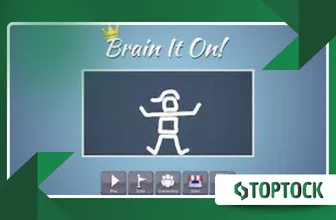
¡Pon tu cerebro en marcha! challenges players to solve physics-based puzzles using creativity instead of memorization. By drawing shapes that interact with gravity and momentum, each level becomes an experiment rather than a test.
Anuncios
The game rewards curiosity, patience, and unconventional thinking, offering a rare mobile experience where intelligence, not speed or spending, determines progress time, players learn through failure and discovery.
Introduction and Content Overview
Interest in physics-based puzzle games has matured alongside a broader fatigue with shallow mobile entertainment. What draws attention here is not spectacle, but friction — the productive kind that slows thinking.
This article examines how the game works, why its design philosophy matters, and what explains its endurance years after release, focusing on practical value rather than hype.
Resumen
Anuncios
- What Brain It On! actually is
- How its mechanics shape thinking
- Why creative constraint changes problem-solving
- When and where the game fits best
- Which cognitive skills it sharpens
- What separates it from similar titles
What Is Brain It On! and Who Developed It?
Developed by Orbital Nine Games, Brain It On! emerged from the independent mobile scene with a deceptively modest premise: draw shapes, trigger physics, reach a goal.
First released in 2016, the game has aged unusually well. That durability comes from timeless mechanics rather than seasonal content or cosmetic reinvention.
There is no single “correct” answer to most puzzles. This absence, subtle but radical, shifts responsibility entirely onto the player’s reasoning process.
How Does Brain It On! Gameplay Work in Practice?
Each level presents a constraint, not a script. Players draw lines, circles, or wedges, then watch physics take over with unapologetic consistency.
Gravity never negotiates. Momentum never forgives sloppy thinking. When a solution fails, the reason is visible, often immediately, which changes frustration into feedback.
Over time, players notice something counterintuitive: elegant solutions tend to be simpler, not more elaborate. Excess usually collapses under its own weight.
Why Do Physics-Based Puzzles Encourage Creative Thinking?
Traditional puzzles reward recognition. Physics puzzles reward reinterpretation. That difference matters more than it seems.
By refusing to funnel players toward a predefined path, Brain It On! nudges thinking sideways. Many discover they solve problems better after abandoning their first idea.
This mirrors real-world reasoning, where constraints exist, but progress depends on reframing the question rather than forcing an answer.
Which Skills Does the Game Quietly Develop?
Spatial reasoning improves almost accidentally. Predicting how an object will fall or rotate becomes second nature after repeated exposure.
There is also a subtler skill at work: restraint. Learning when to stop drawing, when to trust physics instead of overcorrecting, becomes part of mastery.
Leer más: Puzzle & Dragons: Combina orbes para invocar monstruos y superar mazmorras.
Without presenting itself as educational software, the game teaches principles many people struggled to grasp in formal classrooms.
When Is Brain It On! Best Played?
The puzzles respect limited attention spans. A single challenge can be completed in under a minute, yet linger in thought far longer.
Longer sessions reveal a different rhythm. Earlier puzzles resurface, not as chores, but as invitations to improve solutions that once felt “good enough.”
++ Blendoku: Lógica de bloques de color que pone a prueba tu estrategia visual
This flexibility makes the game unusually compatible with reflective play, rather than compulsive engagement loops.
What Makes It Stand Apart From Similar Puzzle Games?
Many puzzle games disguise rigidity behind clever visuals. Here, rigidity is absent, and that absence can feel unsettling at first.
Hints are scarce, hand-holding nonexistent. Some players misinterpret this as difficulty, when it is really an insistence on intellectual autonomy.
That design choice limits mass appeal slightly, but deepens trust with players who value agency over reassurance.
Which Platforms Support the Game in 2026?
Availability has never been a barrier. The game runs smoothly on modern devices without demanding cutting-edge hardware.
It remains accessible through the Google Play Store and the Apple App Store, with feature parity preserved across platforms.
Lea aquí: Simulador de conducción extrema: supera los límites con carreras urbanas de alta velocidad
This consistency avoids fragmenting the experience, a common problem in long-lived mobile titles.
Platform and Monetization Snapshot
| Característica | Detalles |
|---|---|
| Lanzamiento inicial | 2016 |
| Revelador | Orbital Nine Games |
| Plataformas | Android, iOS |
| Business Model | Free with optional premium unlock |
| Juego sin conexión | Sí |
These details are drawn from official store listings and developer information, remaining accurate as of early 2026.
How Is Monetization Handled Without Undermining Design?
Monetization is restrained to a one-time premium unlock. No timers. No artificial scarcity. No pressure disguised as generosity.
Free players experience enough content to understand the design philosophy before paying, which subtly communicates confidence rather than desperation.
For broader context on sustainable mobile design, this analysis from Game Developer offers relevant industry perspective.
What Sustains Long-Term Engagement?
Revisiting solved puzzles becomes strangely compelling. Solutions that once felt clever start to look inefficient under a more experienced eye.
The game never explicitly asks players to optimize, yet optimization emerges naturally as understanding deepens.
That quiet invitation to self-improvement extends the game’s lifespan far beyond its level count.
Who Benefits Most From Playing?
The audience skews toward adults who enjoy thinking slowly and deliberately, though students and educators also find unexpected value here.
Without competition or scoring pressure, the experience feels private, almost meditative, which explains its cross-generational appeal.
Engineers, designers, and logic enthusiasts often recognize familiar mental patterns beneath the simplicity.
Conclusion: Why This Game Still Matters
Brain It On! survives because it respects the player’s intelligence without advertising that respect. Nothing here shouts for attention.
By anchoring creativity in physical rules rather than narrative tricks, it delivers a rare form of challenge that remains relevant long after trends fade.
Readers interested in how problem-solving games influence cognition can explore research perspectives from the
American Psychological Association.
Preguntas frecuentes (FAQ)
What is Brain It On! about?
It is a physics-based puzzle game where players draw shapes to solve challenges governed by realistic physical interactions rather than fixed solutions.
Is it appropriate for children?
Yes. There is no violent or inappropriate content, though some puzzles may challenge younger players without adult guidance.
¿El juego requiere una conexión a Internet?
No. Once installed, all puzzles are playable offline.
Are multiple solutions possible?
Most challenges allow several valid approaches, which is central to the game’s design philosophy.
Is the game still supported in 2026?
Yes. While major content updates are rare, compatibility and performance support continues across current devices.
++ See if you can solve these physics puzzles
Popular ahora