Los nuevos niveles de Sky Roller introducen obstáculos más difíciles.
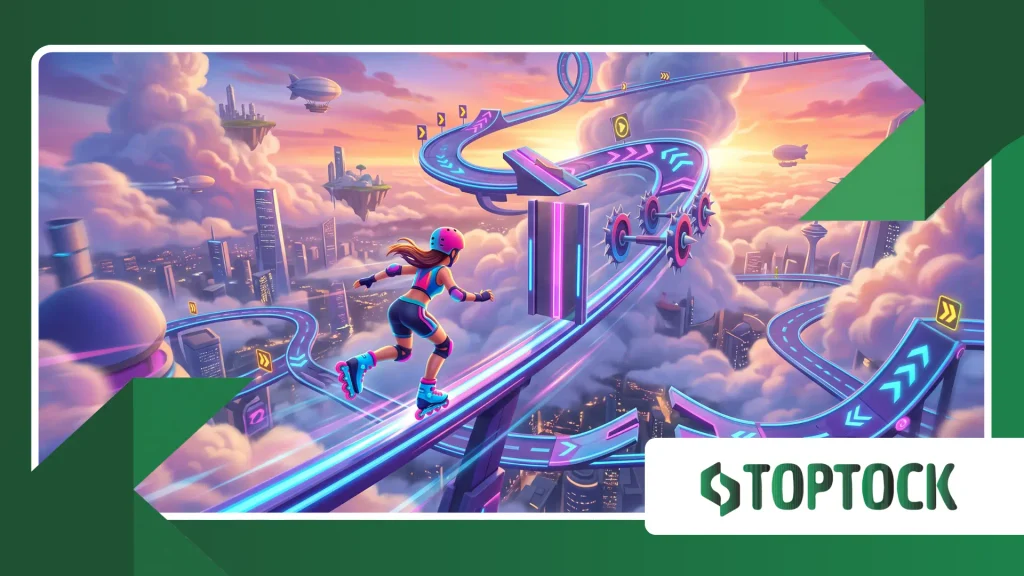
The introduction of Sky Roller new levels brings a steep jump in difficulty, featuring complex moving hazards, tight precision platforms, and faster track speeds that test even veteran players.
Anuncios
Mastering the high-speed, fast-reflex gameplay of Homa Games’ hit mobile title gets significantly harder as you advance through the campaign.
Whether you are aiming to maintain your perfect win streak or trying to unlock elite cosmetic rewards, understanding these updated mechanics is critical to surviving the late-game tracks.
Conclusiones clave
- Dynamic Hazard Mechanics: Recent updates replace static blocks with moving pendulums, rotating blades, and narrowing pathways.
- Pro Stance Control: Success in higher stages relies on mastering micro-adjustments and timing split-leg stance shifts.
- Predictive Positioning: Navigating high-speed levels requires looking several segments ahead rather than focusing solely on character skates.
- Visual Clarity: Selecting high-contrast equipment and clean silhouetted characters directly improves edge clearance awareness.
What Are the Hardest New Obstacles in Sky Roller New Levels?
Recent update patches to the casual arcade favorite have redesigned late-stage track layouts to push player reaction times to their absolute limits.
Earlier stages relied on stationary blocks and simple widening gaps, but the newest level packs introduce active hazards that move unpredictably across the course.
Anuncios
To navigate these updated tracks successfully, players must adapt to hazards that actively disrupt rhythm, force rapid spatial recalculations, and require absolute precision under extreme time pressure.
| Tipo de obstáculo | Introduction Stage | Primary Risk Factor | Optimal Counter-Strategy |
| Swinging Pendulums | Level 120+ | Lateral collision & knockback | Center alignment; time entrance to follow swing arc |
| Narrow Razor Beams | Level 150+ | Precision loss & immediate fall | Maximum leg contraction via controlled inward swipe |
| Dual Rotating Blades | Level 200+ | Variable timing windows | Pause progression or align stance at blade apex |
| Split Elevation Ramps | Level 250+ | Misaligned landing trajectories | Match leg width precisely to target landing platform |
The most frequent run-killer in the updated campaign is the Swinging Pendulum hazard. Unlike stationary barriers where you simply adjust your stance width, pendulums require precise velocity control.
You must calculate the arc of the obstacle while maintaining high forward momentum, making split-second decisions to pass either before or after the hazard sweeps across the track.
Narrow Razor Beams present a completely different mechanical challenge. These razor-thin pathways force players to hold a fully closed leg stance for extended durations.
According to research on human motor skills published by the Institutos Nacionales de Salud, sustained high-precision motor inputs under tight time constraints lead to significantly higher error rates in fast-paced tasks.
In the game, holding a narrow stance reduces overall lateral stability, making the roller character far more sensitive to accidental screen swipes.
Dual Rotating Blades add another layer of complexity by introducing intersecting movement patterns. These blades spin horizontally or vertically across the track, leaving tiny, fleeting gaps for passage.
Passing through safely requires matching your forward speed with the exact millisecond a gap opens. Misjudging the rotation speed by even a fraction of a second results in immediate collision and run failure.
Split Elevation Ramps force players to execute two precise maneuvers simultaneously: managing flight trajectory and setting up landing alignment.
When hitting a ramp at high speed, your stance width at the point of takeoff determines how your character travels through the air.
If the landing area consists of two separate narrow beams, you must adjust your legs mid-approach so that each skate lands cleanly on its respective surface upon contact.
How Do You Clear Dynamic Moving Hazards Without Crashing?
Surviving complex moving hazards requires shifting from reactive swiping to predictive positioning.
When approaching a section with moving obstacles, focus your eyes two to three track segments ahead of your character rather than focusing directly on the skates.
By scanning the horizon of the track, you give your brain necessary processing time to calculate obstacle speed, swing trajectory, and spatial gaps before your character reaches the point of impact.
When approaching rotating blades or swinging hammers, identify the origin point of the motion.
If a pendulum swings from left to right, line up your approach on the far left side as soon as the hazard clears that area.
This tactic maximizes your passage window and leaves ample room for recovery if your speed picks up unexpectedly.
Trying to pass against the direction of the swing drastically reduces your margin for error and almost guarantees a collision.
For elevated jump ramps that lead into split platforms, leg positioning must be determined before leaving the ground.
Adjusting stance width mid-air does not alter your trajectory, so your stance at the moment of launch dictates whether you land safely on parallel beams or fall into the abyss.
Always analyze the platform structure behind a ramp prior to hit-detection to ensure smooth landings.
++ La guía del desafío ZigZag ayuda a los jugadores a alcanzar puntuaciones más altas.
Timing your approach around compound obstacles requires patience and subtle movement inputs.
In levels past Stage 200, track designers frequently pair moving pendulums with narrow balance beams, creating multi-layered hazards.
To pass these sections, align your skates with the narrow path first, then adjust your forward momentum to dodge the swinging weight.
Separating complex maneuvers into clear, sequential steps prevents input overload and reduces mechanical mistakes.
Why Is Stance Width Timing Crucial for End-Game Success?
The primary control loop in this arcade runner revolves around expanding and contracting your character’s legs via touch controls.
While early stages permit sloppy positioning, higher difficulty stages enforce strict spatial boundaries.
The mechanical relationship between stance width and stability determines how effectively you can traverse varying terrain types without losing control.
Expanding your stance outwards increases horizontal balance and allows your character to bridge wide gaps, slide across parallel rails, and collect coins distributed across the edges of the track.
However, a wide stance makes your character significantly wider, making it impossible to pass through narrow gateways or avoid thin vertical spikes.
Conversely, contracting your stance inwards reduces your physical footprint, allowing you to slice through tight openings and ride atop single-rail beams.
The tradeoff for this narrow posture is a severe reduction in lateral stability.
While in a tight stance, subtle screen inputs cause aggressive horizontal shifts, increasing the risk of accidentally swerving off the edge of the track.
Expanding your legs too early on approach to a narrow beam causes your skates to clip the outer edges, resulting in an instant crash.
Conversely, contracting your legs too early when navigating wide balance hazards destroys your lateral center of balance.
Advanced players use a technique known as “feathering”—making rapid, micro-swipes to make slight stance adjustments rather than dragging their finger all the way across the display screen.
Leer más: Mi hotel perfecto: Cómo convertir una pequeña empresa en un imperio de la hostelería de lujo.
This keeps your skates responsive to sudden track shifts without over-correcting into a fatal collision.
What Strategies Prevent Speed-Induced Mistakes in Late Stages?
As you progress deeper into the campaign, track velocity naturally accelerates. The increased game speed drastically reduces reaction windows, turning routine obstacles into high-risk maneuvers.
Managing speed effectively requires a combination of visual planning, optimal hand positioning, and disciplined touch execution.
Establish Visual Markers: Use track color changes, floor pattern borders, and side decor as visual cues to trigger your stance adjustments early.
Setting mental checkpoints allows you to initiate stance shifts before reaching the hazard.
Maintain Screen Center: Keep your touch finger centered on the bottom third of your screen to prevent your hand from obstructing incoming track hazards and stealing reaction time.
Utilize Ramps for Course Assessment: Airborne moments provide brief pauses in active control; use these split seconds to scan the incoming platform layout before your skates touch down.
Avoid Over-Steering: Sudden, wide swipes often cause misalignments on landing; stick to subtle, controlled movements.
Mobile interface design guidelines documented by the World Wide Web Consortium emphasize that high-frequency touch interactions suffer from increased input variance during fast animations.
Minimizing unnecessary screen drags reduces input lag and keeps your character aligned.
Which Upgrades and Skins Offer the Best Performance Advantage?
While character customization in casual runners is primarily aesthetic, subtle visual differences between skates and outfits can influence your spatial awareness on dense track layouts.
Selecting equipment that maximizes visual contrast and minimizes screen clutter delivers a tangible gameplay advantage in technical stages.
++ Una pequeña librería convierte la venta de libros en un acogedor negocio móvil.
Brightly colored skates, such as neon yellow, vivid cyan, or bright orange, offer sharp contrast against the blue, purple, and metallic track backgrounds typical of late-game stages.
This visual contrast helps your peripheral vision track edge alignment accurately without requiring you to take your eyes off oncoming obstacles.
Dark or translucent skate models tend to blend into track textures, making precise edge tracking more difficult.
Character silhouettes also play a significant role in visual clarity. Models with sleek, minimal designs provide an unobstructed view of the track directly beneath and around your character.
Outfits featuring large capes, wide skirts, or bulky trailing accessories create visual noise that obscures the placement of your skates relative to razor beams and platform borders.
Preguntas frecuentes
Do new levels in Sky Roller require an active internet connection to play?
No, the core campaign modes and stage progression can be played offline without an active network connection.
However, downloading content updates, claiming daily rewards, and participating in global leaderboard events require an active internet connection.
How do I restart a level quickly after failing a difficult obstacle?
When a crash occurs, tap the instant retry button on the failure screen to restart the track segment immediately.
Avoiding ad-supported revives keeps your gameplay rhythm intact during tough sections, allowing you to maintain focus and momentum.
Are the obstacle patterns on higher stages generated randomly?
No, level layouts in the main campaign are handcrafted with fixed hazard locations and set geometry. While moving obstacles operate on continuous motion loops, their movement patterns and spawn timing remain identical every time you restart the stage.
Can I adjust the control sensitivity for touch swipes?
The game scales touch input directly to your screen resolution without native sensitivity sliders.
To improve touch precision, ensure your device screen is clean and disable any third-party display overlays that might introduce latency into touch processing.
++ ing Sky Tips and Strategies: How to Beat the Hardest Levels
++ Sky Roller Guide: Tips, Cheats & Tricks to Complete All Levels and Unlock Everything
Popular ahora