Stacky Dash: Collect Tiles and Build Bridges to Reach the Goal
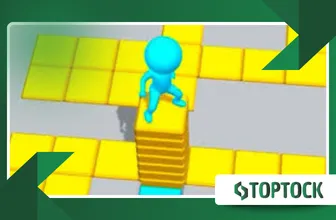
Exploring the addictive mechanics of Stacky Dash, players quickly discover that precision and pathfinding are far more than secondary concerns; they are the literal foundation of survival in this hyper-casual mobile standout.
Anúncios
Summary
- The psychological shift of hyper-casual mechanics in 2026.
- Strategic depth hidden beneath deceptive swiping controls.
- Hard data: player engagement and global performance.
- Advanced pathfinding for maximizing tile efficiency.
- Navigating the architectural complexity of modern levels.
What is Stacky Dash and why does it hook us?
Since its debut, this arcade title has moved past the era of mindless tapping to redefine “stack-and-run” gameplay through a tactile, almost meditative feedback loop.
The core loop is simple: you swipe a character across platforms to gather colored tiles, which instantly form a physical tower beneath your feet.
There is a subtle tension in every move. Success hinges on your ability to mentally map the geometry of the stage while ensuring your “staircase” is tall enough to bridge the next void. It is a game of constant calculation disguised as a colorful distraction.
Casual users might enjoy the low stakes, but those chasing high scores recognize that the game is actually a puzzle of resource management. You aren’t just moving; you are building the very ground you intend to walk on.
Anúncios
How does the tile-stacking mechanic actually work?
Movement in the game is locked to four cardinal directions, a restriction that turns a simple 3D space into a demanding logic grid where one wrong turn can isolate your character.
Every tile you touch is absorbed into your height, providing the physical currency needed to construct bridges over the abyss.
Attempting to cross a gap without enough material results in an immediate fall. This creates a risk-reward dynamic that forces you to explore every corner of a platform, even when the exit is tempting you to cut corners and rush.
++ Save the Girl: Solve Wacky Puzzles to Rescue Her from Danger
The game rewards a specific kind of “efficient greed.” You want every tile available, but taking the wrong path to get them might leave you stranded. It’s about visualizing the shortest route that yields the maximum volume of tiles.
What defines the 2026 experience?
The current landscape of Stacky Dash features procedurally generated layouts that finally solve the problem of repetition, making each run feel like a fresh architectural challenge rather than a memorized pattern. This unpredictability keeps the stakes high during longer sessions.
Visually, the jump to 120Hz support has made the sliding animations feel buttery smooth. It’s an oddly satisfying sensory experience—the way the tiles click into place feels substantial, moving the game away from the “floaty” physics of its early predecessors.
Read more: Tomb of the Mask: Dash Through Neon Mazes at Breakneck Speed
We’ve also seen the rise of “Ghost Runs.” Being able to see the translucent trail of a global champion adds a competitive edge, turning what used to be a solitary pastime into a masterclass in spatial efficiency.
Why is pathfinding the ultimate skill?
Efficiency is the thin line between a mediocre finish and a “Three-Star” run. In this environment, every wasted tile is a direct hit to your end-game multiplier, meaning “good enough” usually isn’t enough for the leaderboard.
Expert players treat the map like a blueprint. They identify bottlenecks early, knowing that once you cross certain thresholds, there is no going back to pick up missed resources. It’s an exercise in foresight that many casual titles lack.
Learning to double back without trapping yourself is the hallmark of a veteran. It requires a sharp eye for the game’s internal logic—recognizing that the most obvious path is often a trap designed to leave you a few tiles short of the final chest.
For a deeper look at how these engagement loops are designed, Sensor Tower provides excellent data on how hyper-casual mechanics have matured to retain players longer than ever before.
Which strategies lead to the highest multipliers?
A common mistake is rushing toward the center of a platform. Instead, hug the outer edges first. Clearing the perimeter ensures you don’t cut off your own access to the corners, which are usually where the most valuable tile clusters hide.
Keep a close watch on color-coded gates. These aren’t just aesthetic; they act as skill checks that demand a specific stack height to pass. If you’ve been sloppy with your pathfinding, these gates will end your run before you even see the finish line.
++ Snowboard Party: Glide, Flip, and Spin Down Snowy Mountains
The multiplier zones at the end of each stage scale exponentially. This means the last five tiles in your stack are infinitely more valuable than the first five. Greed, in this specific context, is your most effective tool for progression.
Data Insights: The Arcade Evolution in 2026
The following data reflects how the genre has stabilized and grown, proving that “casual” no longer means “disposable” in the mobile market.
| Metric | 2024 Baseline | 2026 Current Data |
| Monthly Active Users | 45 Million | 62 Million |
| Average Session Length | 4.2 Minutes | 6.8 Minutes |
| Retention Rate (Day 30) | 8% | 14% |
| Global Download Growth | +12% | +25% |
When should you rely on boosters?
Power-ups like “Magnetism” can be lifesavers, but relying on them too early stunts your mechanical growth.
These tools are best reserved for the “Elite World” stages where the layouts become genuinely devious and the margin for error is non-existent.
The “Path Preview” is another high-value asset, though using it feels a bit like cheating the puzzle. Save these for levels where the path forward is obscured by traps or multi-level platforms that defy standard logic.
During seasonal events, the “Double Tile” booster becomes the most important item in your inventory. It is the only reliable way to hit the upper echelons of the global rankings when the competition is at its peak.
What about character customization?
Customization has evolved far beyond basic skins. The 2026 catalog includes models with unique visual weights.
While the physics remain consistent, many players swear that certain character silhouettes make it easier to judge distances between platforms.
“Victory Trails” have become the ultimate status symbol. These shimmering paths follow your character and signify that you’ve conquered specific high-difficulty tiers. It’s a subtle way to flex your skill without saying a word.
Monthly seasonal sets keep the aesthetic fresh, but they also create a sense of urgency. Missing out on a limited-edition skin feels like losing a piece of the game’s history, which drives the high daily login numbers we see today.
Final Thoughts
Mastering Stacky Dash is an exercise in patience and spatial geometry. It’s rare to find a game that balances such simple controls with a genuine need for tactical thinking.
The satisfaction of reaching the goal with a massive tower of tiles remains one of the most cohesive experiences in the arcade category.
The game respects the player’s time by offering quick, punchy levels that still demand total focus. As we move further into 2026, it stands as a testament to the idea that a great mechanic doesn’t need to be complex to be profound.
Keep your eyes on the corners, plan your bridges carefully, and remember that in this game, your height is your only currency.
To stay informed on how mobile hardware is pushing these games further, check the latest industry analysis at TechCrunch.
FAQ
Is the game truly free?
It is free to download and play. Revenue is driven by ads and optional cosmetics, meaning you can reach the top of the leaderboards without spending a dime if your skills are sharp enough.
Can I play without an internet connection?
The core levels are playable offline. however, you’ll need a connection to sync your scores to the global leaderboards or to participate in the high-stakes seasonal events.
Why do I keep falling short of the finish line?
You are likely taking the most direct path. The “shortest” path is rarely the best one; you need to take longer, more winding routes to ensure you collect enough tiles to build your final bridge.
Are there secret levels?
Yes. Achieving a “Perfect” rating on all levels in a single world typically unlocks a hidden tier of difficulty designed to challenge even the most experienced stackers.
How do I get more coins?
Coins are earned by reaching the highest multipliers at the end of a level. The taller your stack when you hit the goal, the more currency you’ll have for new skins and trails.
++ Stacky Dash: Dash, Stack, and Conquer the Maze
Popular Now