
Tiles Hop: Bounce to the Beat in a Colorful Rhythm Game

The mobile gaming landscape is often cluttered with clones, yet Tiles Hop stands as a rare intersection where rhythmic precision meets a genuine, neon-soaked aesthetic that actually feels rewarding.
Anúncios
Summary of the Musical Journey
- Mechanical Depth: Beyond simple bouncing to rhythmic mastery.
- Sonic Integration: How tracks dictate the physical map.
- Visual Evolution: The leap toward immersive 3D spatial design.
- Technical Specs: Performance benchmarks for the 2026 hardware era.
- Social Ecosystem: Competitive loops that drive global rankings.
What defines the magnetic pull of Tiles Hop right now?
There is something hypnotic about the way this game strips away complexity to focus on the raw connection between sound and motion.
While many titles try to overwhelm the player with buttons, Tiles Hop relies on a singular, fluid gesture. In 2026, this isn’t just a casual distraction; it’s a tactile response to the music we consume daily, turning listeners into active participants.
The current iteration feels more responsive than ever, thanks to haptic engines that mirror the “thump” of a bassline directly into your palms. It’s a sensory loop that feels instinctive.
By aligning the gameplay with trending global hits, the experience stays tethered to the cultural moment rather than drifting into the graveyard of forgotten arcade apps.
Anúncios
How does the audio engine dictate the physical world?
The game doesn’t just play music in the background; it translates sonic frequency peaks into the literal distance between platforms.
This algorithmic approach means the level architecture is a physical manifestation of the song’s energy. When the beat drops, the spatial gap widens, forcing a frantic, high-stakes leap that mirrors the intensity of the audio.
This synchronization creates a flow state that is surprisingly difficult to break. It requires a specific brand of focus where you stop looking at the tiles and start feeling the tempo.
The game effectively forces your brain to predict movement based on melody, which is a sophisticated cognitive trick for a “simple” arcade game.
Procedural generation ensures that even a familiar track feels slightly unpredictable upon a second or third visit.
Read more: Don’t Tap the White Tile: Tap to the Rhythm Without a Single Mistake
This prevents the “memory trap” where players simply memorize patterns, keeping the emphasis on raw reflexes and musical intuition.
Why has the 2026 update shifted the arcade meta?
The latest technical overhaul has introduced lighting physics that were once reserved for consoles. We are seeing real-time reflections on the spheres and dynamic shadows that react to the music’s “pulse.”
It’s no longer just a ball on a screen; it’s a high-fidelity light show that happens to be interactive.
Beyond the eye candy, the move toward lossless audio formats is a subtle but massive win for the player base.
The clarity of the high-end frequencies makes the rhythmic cues sharper, which translates to better timing. If you are playing with decent hardware, the difference in “rhythmic lag” is virtually non-existent now.
The “Creator Mode” is perhaps the most significant cultural shift within the app. By allowing users to feed their own audio files into the AI engine, the game has outsourced its longevity to the players.
++ Idle Archer: Defend Your Tower and Upgrade with Each Wave
This turns the game into a personalized jukebox that builds a playground around your specific taste.
Which features separate this title from the rhythm clones?
Most rhythm games trap you in a linear, four-lane highway that feels claustrophobic and mechanical. Tiles Hop breaks that mold by utilizing 3D space, allowing the ball to drift laterally with a sense of momentum and weight that feels grounded in physics. It’s less like typing on a keyboard and more like steering a vehicle.
The inclusion of “Magic Tiles” and strategic power-ups adds a layer of risk-management that purist rhythm games often lack.
Deciding whether to veer off-course for a score multiplier requires a split-second calculation of risk versus reward. It’s these tiny tactical decisions that separate the casual players from the leaderboard elite.
Technical benchmarks highlight that Android Developers prioritize input latency as the “make or break” factor for this genre.
This game succeeds because it minimizes the gap between a finger swipe and the on-screen reaction to nearly imperceptible levels.
Technical Performance and Player Statistics
The scale of the game is staggering when you look at the raw data, reflecting a level of optimization that caters to both budget devices and flagship powerhouses.
| Metric | 2026 Data Points | Operational Impact |
| Total Downloads | Exceeding 1.2 Billion | Guaranteed longevity and full lobbies |
| Max Refresh Rate | 144Hz Native Support | Eliminates motion blur during fast songs |
| Initial Footprint | 185 MB | Extremely efficient resource management |
| Active Song Count | 15,000+ Licensed Tracks | Covers every niche from Phonk to Jazz |
| Touch Latency | Sub-15ms on 5G hardware | Critical for “Perfect” hit accuracy |
What are the most effective strategies for elite scoring?
The biggest mistake novices make is over-correcting. Success in this environment is about micro-movements and staying calm during high-BPM sequences.
Instead of chasing the ball, you should be aiming for the center of the upcoming tile. Landing “Perfect” hits isn’t just about points; it builds a momentum multiplier that is impossible to recover if lost.
Sound cues are often more reliable than visual ones. If a song has a complex syncopated beat, trust your ears over your eyes.
The visuals can sometimes be distracting during intense neon flashes, but the rhythm remains a constant guide that won’t lead you astray.
Read here: Idle Supermarket Tycoon: Expand Your Store and Keep Shoppers Happy
Calibration is also frequently ignored. Take thirty seconds to adjust the sensitivity in the settings. A ball that moves too slowly will leave you stranded on fast EDM drops, while a ball that is too “twitchy” will cause you to overshoot the platforms during slower, melodic bridges.
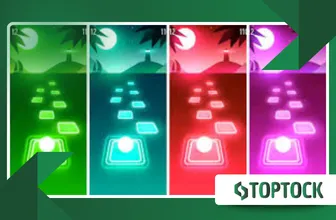
The evolution of the rhythmic landscape
Watching Tiles Hop transform from a basic time-killer into a high-fidelity sensory experience says a lot about where mobile gaming is headed.
It’s no longer enough to just have a gimmick; you need a polished, responsive, and socially connected ecosystem to survive. As long as people love music and the thrill of a high score, this neon sphere will keep bouncing.
To see how these interactive elements are reshaping the broader industry, the Unity Gaming Report offers deep insights into the fusion of music and mobile software.
Frequently Asked Questions (FAQ)
Does the game work without a data connection?
Offline play is fully supported for any songs you have previously cached or downloaded. You only need to go online to sync your high scores to the cloud or to browse the latest additions to the music library.
How does the custom song AI work?
When you upload a track, the engine performs a “spectral analysis” to identify transients (the loud, percussive hits). It then plots tiles along a 3D path that corresponds to these beats, ensuring the gameplay feels “baked-in” rather than random.
Is there a noticeable benefit to high-refresh-rate screens?
Absolutely. At 120Hz or 144Hz, the “ghosting” effect of the moving tiles is eliminated. This makes it much easier to track the ball’s trajectory during high-speed segments, providing a clear competitive advantage over standard 60Hz displays.
Are there ways to play without constant ads?
The game offers a premium tier that removes forced interruptions. However, even for free users, the ad integration is primarily built around voluntary rewards, such as reviving after a fall or unlocking specific premium tracks.
++ Music Ball Hop Tiles 3D Beat Master
Popular Now